How to Read a Synastry Chart
Start with the tightest contacts involving a personal planet, then read each one in a single direction. Weigh the overall balance, add the house overlays, and finish with the composite chart for a picture of the two people together.
The two charts as threads
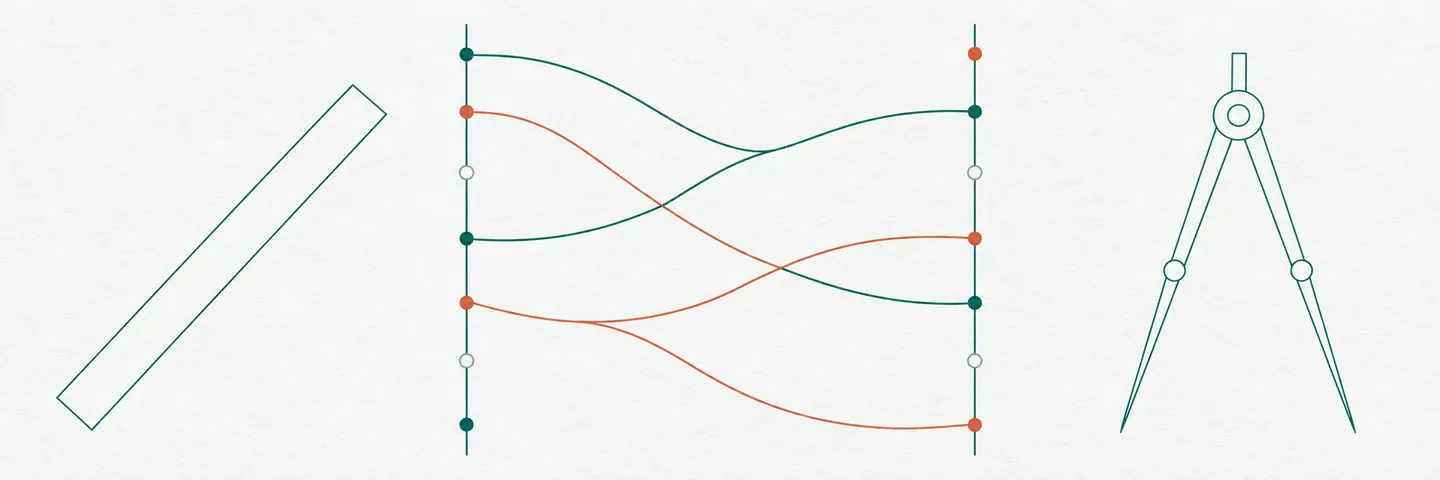
Person A on the left, person B on the right. Each thread joins a point of A to a point of B. Tap a thread or a planet to read it.
- Harmonious
- Challenging
- Thicker is tighter
- Conjunction
- Sextile
- Square
- Trine
- Opposition
How to read it
- Harmonious solid thread, round badge. The two planets ease each other.
- Challenging dashed thread, diamond badge. Friction that asks for effort.
- Thicker is tighter. The width of a thread shows how close the aspect is to exact.
- Conjunction
- Sextile
- Square
- Trine
- Opposition
Tap a thread or a planet
The tightest link is A’s Mars trine B’s Moon, orb 0°13′. Tap it, or any planet, to read what it means.
Strongest links6 tightest
MarsATrineMoonB
Person A's Mars trine Person B's Moon brings a relaxed rhythm between initiative and the comfort that helps the other person unwind.
VenusAOppositionSunB
The pull is appealing and awkward: Person A's Venus opposite Person B's Sun can leave A admiring B while wanting a softer response.
AscendantASquareMarsB
A’s first impression in square with B’s drive and desire: the two pull in different directions, creating friction that pushes both people to act.
MarsATrineAscendantB
A’s drive and desire in trine with B’s first impression: the two flow together with little effort, which feels natural and easy to take for granted.
SunATrineMoonB
Person A's Sun trine Person B's Moon often helps B settle around A's self-assurance, with care and appreciation passing between them naturally.
SunAConjunctionAscendantB
A’s sense of self in conjunction with B’s first impression: the two sit side by side, so their qualities blend into one.
Check the birth details first
Check both birth dates, times, and places before reading the chart. These details set the positions used in the comparison, and the birth time matters for the Ascendant, Midheaven, and houses. A synastry chart compares two birth charts to show where their planets and points meet. An aspect is a geometric link between two positions, such as a trine or square. These terms help you name what the chart displays without turning it into a verdict.
The sample couple, two invented people, Person A and Person B, both have a known birth time. That lets the example include Ascendants and house overlays. If either birth time is unknown, the angles and houses are removed from the reading because their positions cannot be set reliably. The planet contacts can still be read, but the chart gives less detail about how each person experiences the other's presence in daily life.
Start with the tightest contacts
An orb is the gap between two points and the exact angle of an aspect; a smaller orb makes a closer, stronger link. Begin with the personal planets, which include the Sun, Moon, Venus, and Mars, then notice how close each contact is. In the sample, Person A's Mars trine Person B's Moon has an orb of 0.22 degrees, within an allowed orb of 7 degrees. It is the closest contact in the list, so it is a clear place to begin.
Next, Person A's Venus opposite Person B's Sun has an orb of 2.47 degrees, within an allowed orb of 7 degrees. Person A's Ascendant square Person B's Mars has an orb of 0.6 degrees, within an allowed orb of 5.5 degrees. These are close links too, though one involves the Ascendant. The calculator's allowed orb shows which links count in this chart; the smaller orb tells you which counted links are closest.
Read each contact in one direction
Say whose planet, which aspect, and whose planet, in that order. Person A's Mars trine Person B's Moon is not the same sentence as Person A's Moon trine Person B's Mars. The planets belong to different people in each reading, so the order shows who brings which quality and who meets it. The direction does not make one person or side stronger. Keeping the names attached to the planets stops a long table from blurring into a list of aspect names.
For the sample contact, A brings Mars: direct action, initiative, and a way of pursuing what matters. B brings the Moon: emotional reactions and a need for comfort. The trine describes an easy link between these parts, so A's drive can sit naturally beside B's feelings. In an everyday moment, A may take the lead while B responds readily. That is a theme to notice, not a rule for how either person behaves.
Weigh both kinds of contact
The sample has 31 contacts in total: 12 harmonious and 19 challenging. The lopsided count says little on its own. A table may show many links because it includes several kinds of planets and points, and the count does not explain how people handle them. Squares and oppositions describe friction, such as different timing or clashing preferences. Trines and sextiles describe ease, but easy patterns can be taken for granted when no one makes an effort to notice them.
Neither harmonious nor challenging contacts make a relationship good or bad. Read each contact for the theme it brings, then consider how it sits beside the others. A square between personal planets can describe a recurring difference that people learn to name. A trine can describe a point of easy understanding that rarely gets discussed. The labels sort the contacts by style; they do not measure the care, respect, or choices between two people.
Add the house overlays both ways
A house overlay is one person's planet falling in a house of the other person's chart. Read Person A's planets in Person B's houses, then reverse direction and read Person B's planets in Person A's houses. In the sample, A's Sun and Venus fall in B's 12th house, while A's Moon falls in B's 4th house. These placements suggest areas of life where B may notice A's presence, but they do not describe the same experience from A's side.
In the other direction, B's Venus falls in A's 7th house and B's Mars falls in A's 3rd house. The 7th house brings attention to one-to-one relating, while the 3rd house brings attention to conversation and everyday exchanges. B's Venus there is not interchangeable with A's Venus in B's 12th house. The two directions describe different viewpoints. Read both, and keep each person's planet attached to the receiving house.
Look at the composite chart last
The composite chart is made from the midpoints of the two birth charts and offers a picture of the two people together. Read it after the contacts and house overlays, so its themes have context. A composite placement can describe what becomes prominent when the two people meet, such as how they handle shared plans or present themselves together. It adds a view of the relationship as a unit; it does not replace the details of how one person's planets meet the other's.
Keep the reading descriptive
Treat the reading as a set of themes to talk about, not a verdict on the relationship. A few close contacts can matter more in conversation than a long list of loose links. What people do with a contact matters more than the contact itself: one person can name a difference, listen, and adjust, while another moment brings the same difference into sharper view. The chart describes patterns people may recognize; their choices give those patterns their place in daily life.
Questions
Which aspects matter most in synastry?
The closest contacts involving personal planets are a useful starting point. They link themes people often notice in everyday interactions, such as affection, feelings, or initiative. Read the planets and direction first, then consider the aspect and its orb in the context of the whole chart.
How close should the orb be?
A smaller orb means the two points sit closer to the exact angle. The allowed orb depends on the points and the aspect, so there is no single cutoff for every contact. A contact outside the calculator's allowed orb is not counted in its table.
Should I count harmonious and challenging aspects?
You can use the counts to see the chart's broad mix, but a total cannot explain how the two people respond to a contact. Look at the specific planets, direction, and closeness as well. One repeated theme may deserve more attention than several unrelated contacts.
What if my chart has many squares?
A large number of squares means the table contains many links associated with friction. It does not describe how often conflict happens or how either person handles it. Read the closest personal planet contacts first, then look for the particular preferences or habits the squares bring into view.