Synastry Without a Birth Time
Two dates are enough: see which aspects hold all day and which depend on the hour.
Synastry resultSample couple
Person A Sep 29, 1990, time not knownPerson B Mar 14, 1988, time not known
Two invented people, not real ones. Enter your own birth details above and press the button to replace this result.
24 aspects between the two charts: 8 harmonious and 16 challenging.
8 of them depend on the hour, because a birth time is not known.
Good to know
- Person A: no birth time. The planets are placed at noon of the birth day, and the Ascendant, the Midheaven and the houses are left out. Aspects marked “depends on the hour” may not hold at another time of the day.
- Person B: no birth time. The planets are placed at noon of the birth day, and the Ascendant, the Midheaven and the houses are left out. Aspects marked “depends on the hour” may not hold at another time of the day.
The two charts as threads
Person A on the left, person B on the right. Each thread joins a point of A to a point of B. Tap a thread or a planet to read it.
- Harmonious
- Challenging
- Thicker is tighter
- Conjunction
- Sextile
- Square
- Trine
- Opposition
How to read it
- Harmonious solid thread, round badge. The two planets ease each other.
- Challenging dashed thread, diamond badge. Friction that asks for effort.
- Thicker is tighter. The width of a thread shows how close the aspect is to exact.
- Conjunction
- Sextile
- Square
- Trine
- Opposition
14 tightest of 24 links
Tap a thread or a planet
The tightest link is A’s Sun trine B’s Moon, orb 1°19′. Tap it, or any planet, to read what it means.
Strongest links6 tightest
VenusAOppositionSunB
The pull is appealing and awkward: Person A's Venus opposite Person B's Sun can leave A admiring B while wanting a softer response.
JupiterASquareVenusB
With Person A's Jupiter square Person B's Venus, A's big-hearted plans meet B's preference for pleasures that feel considered and personal.
MercuryAOppositionSunB
The pull feels lively and uneasy at once. Person A's Mercury opposite Person B's Sun brings A's questions face to face with B's self-expression.
SunASquareSaturnB
Person A's Sun square Person B's Saturn often turns A's push for recognition into a test of patience around B's rules and standards.
North NodeASquareVenusB
When Person A's north node squares Person B's Venus, B's preferred comforts can meet A's insistence on a change that feels necessary.
VenusAOppositionNorth NodeB
Person A's Venus opposite Person B's north node draws B toward A's warmth while placing familiar pleasures beside a call for change.
All aspects24 found
Every aspect found between the two charts, tightest first. Orb is the distance from the exact angle.
| No. | Person A | Aspect | Person B | Orb | Nature |
|---|---|---|---|---|---|
| 1 | SunA | Harmoniousdepends on the hour | MoonB | 1°19′ | Harmoniousdepends on the hour |
| 2 | VenusA | Challenging | SunB | 2°57′ | Challenging |
| 3 | MarsA | Harmoniousdepends on the hour | MoonB | 4°14′ | Harmoniousdepends on the hour |
| 4 | MoonA | Harmoniousdepends on the hour | MoonB | 6°09′ | Harmoniousdepends on the hour |
| 5 | MoonA | Challengingdepends on the hour | JupiterB | 0°12′ | Challengingdepends on the hour |
| 6 | JupiterA | Challengingdepends on the hour | MoonB | 0°47′ | Challengingdepends on the hour |
| 7 | JupiterA | Challenging | VenusB | 1°09′ | Challenging |
| 8 | MercuryA | Challenging | SunB | 4°49′ | Challenging |
| 9 | North NodeA | Harmoniousdepends on the hour | MoonB | 1°46′ | Harmoniousdepends on the hour |
| 10 | MercuryA | Harmoniousdepends on the hour | MarsB | 5°10′ | Harmoniousdepends on the hour |
| 11 | SunA | Challenging | SaturnB | 3°59′ | Challenging |
| 12 | North NodeA | Challenging | VenusB | 3°42′ | Challenging |
| 13 | VenusA | Challenging | North NodeB | 4°16′ | Challenging |
| 14 | SaturnA | Challenging | MarsB | 4°22′ | Challenging |
| 15 | VenusA | Challenging | SaturnB | 4°39′ | Challenging |
| 16 | PlutoA | Harmonious | MarsB | 1°46′ | Harmonious |
| 17 | NeptuneA | Challenging | MarsB | 2°33′ | Challenging |
| 18 | NeptuneA | Harmonious | VenusB | 2°38′ | Harmonious |
| 19 | MercuryA | Challenging | North NodeB | 3°29′ | Challenging |
| 20 | SunA | Challenging | NeptuneB | 4°04′ | Challenging |
| 21 | UranusA | Harmonious | VenusB | 3°29′ | Harmonious |
| 22 | VenusA | Challenging | UranusB | 3°34′ | Challenging |
| 23 | SunA | Challengingdepends on the hour | UranusB | 5°04′ | Challengingdepends on the hour |
| 24 | North NodeA | Challenging | JupiterB | 4°11′ | Challenging |
The same pair as a wheelBi-wheel
Person A on the inner ring, person B on the outer ring, the tightest aspects as lines across the middle. Tap a planet or a line. The table under the wheel lists the positions it is drawn from.
- AInner ring: Person A
- BOuter ring: Person B
Tap a thread or a planet
The tightest link is A’s Sun trine B’s Moon, orb 1°19′. Tap it, or any planet, to read what it means.
Positions as a table
| Point | A A | B B |
|---|---|---|
| Sun | Lib 5°55′ | Pis 24°20′ |
| Moon | Aqu 1°05′ | Aqu 7°15′ |
| Mercury | Vir 19°32′ | Aqu 27°50′ |
| Venus | Vir 27°17′ | Tau 9°10′ |
| Mars | Gem 11°29′ | Cap 14°21′ |
| Jupiter | Leo 8°01′ | Tau 1°17′ |
| Saturn | Cap 18°44′ | Cap 1°56′ |
| Uranus | Cap 5°42′ | Cap 0°51′ |
| Neptune | Cap 11°48′ | Cap 9°59′ |
| Pluto | Sco 16°08′ | Sco 12°20′ R |
| North Node | Aqu 5°28′ R | Pis 23°01′ R |
An orb is the distance, in degrees and minutes, between an aspect and its exact angle. A tight orb is a strong contact; each aspect has its own largest orb.
Yes, a synastry chart can be worked out without a birth time. The date places the planets, but not the Ascendant, Midheaven or houses. The calculator marks contacts that depend on the hour.
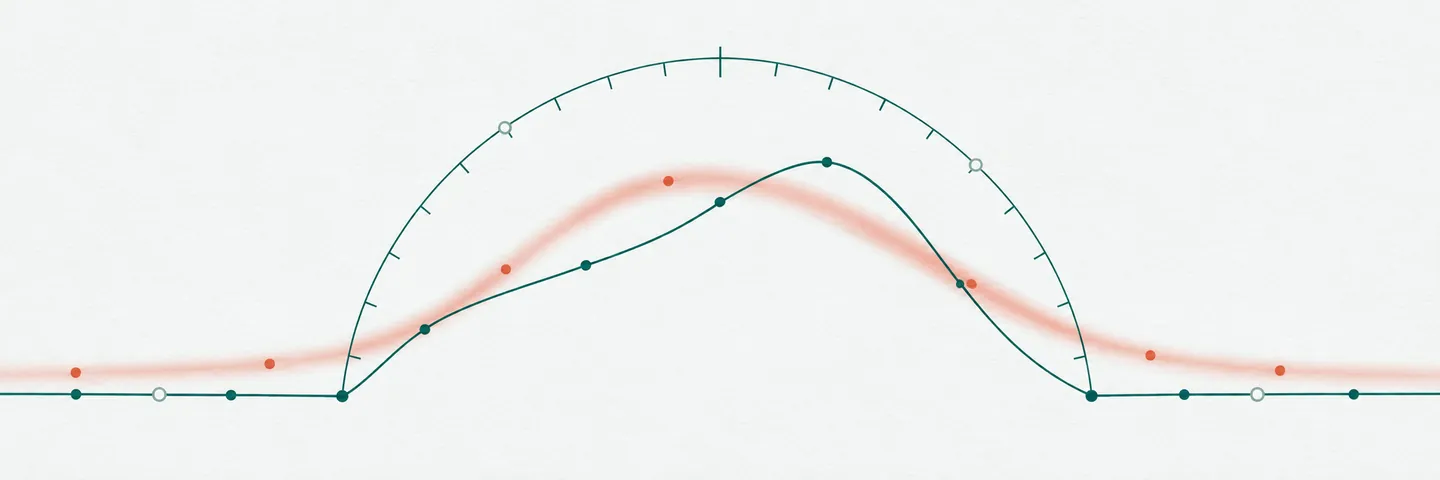
What a Missing Time Takes Away
Without a birth time, the chart cannot place that person's Ascendant, Midheaven or any houses. That means there are no house overlays for them and no contacts to their angles. Synastry compares two birth charts to describe how their placements meet, but this part of the comparison needs a known time. In the sample couple, 11 of 31 contacts involve an Ascendant or Midheaven, so those contacts cannot be assessed when the relevant time is missing.
Planet Contacts Can Still Hold
Many parts of the comparison remain usable. Contacts between planets, and the north node, can be read when they hold through the whole day. The date gives a starting point for those placements, even if the clock time is unknown. A contact that stays in place from early to late is not dependent on choosing one particular hour. Its meaning describes a theme the two people meet, rather than a fixed account of how the relationship must unfold.
The Moon Needs More Care
The Moon moves about 13 degrees in a day, while the Sun moves about 1 degree. The Ascendant turns about 15 degrees an hour, which is why a missing time matters so much for angles. A contact involving the Moon can shift as the day passes. The same is true when a fast point meets a slow one: the contact may be present at one hour and absent at another. Those contacts need a careful label instead of a settled reading.
How the Calculator Marks Uncertainty
For a person with no known time, the chart is cast for noon, with no Ascendant, Midheaven or houses shown. The calculator checks a contact involving a fast point at 00:00, noon and 23:59. If it does not hold at all three times, the result says "depends on the hour." Read that contact as possible, not settled: the noon chart is a useful estimate, but it does not resolve the timing. Adding a birth time later removes that doubt. Each marked contact is listed on its own line, so you can see at a glance which ones depend on the hour and which do not.
Questions
Can you do synastry without a birth time?
Yes, you can compare the planets using birth dates alone. The missing time leaves the Ascendant, Midheaven and houses unknown, so some contacts cannot be assessed. The calculator marks contacts that change during the day as dependent on the hour.
What if only one person knows their birth time?
The timed chart can include its angles and houses, while the untimed chart has none. Contacts between the timed person's angles and the other person's planets cannot be worked out fully. Planet contacts that hold all day can still be compared.
Which planets are affected by an unknown birth time?
The Moon is the planet most likely to shift enough during the day to change a contact. The Sun moves more slowly, while the Ascendant changes quickly. Any contact involving a fast point is checked for whether it holds across the day.
How can I find out my birth time?
A birth certificate or hospital records are the usual places to find a birth time. If neither gives a time, the chart can still show contacts that hold all day, while contacts that vary by hour remain uncertain.