What Is a Composite Chart in Astrology?
A composite chart is one chart made for two people, with each point placed halfway between the same point in their birth charts. It is read as a picture of the relationship, not of either person alone.
Composite chartEqual houses
Each point is the midpoint of the same point in the two charts, taken on the shorter arc.
Tap a planet or a line to read it.
Points of the composite chart
| Point | Sign | Position | House | A Person A | B Person B |
|---|---|---|---|---|---|
| Sun | CapricornCap | 0°12′ | House 3 | Lib 5°47′ | Pis 24°38′ |
| Moon | AquariusAqu | 5°28′ | House 4 | Cap 29°16′ | Aqu 11°39′ |
| Mercury | SagittariusSag | 8°46′ | House 2 | Vir 19°19′ | Aqu 28°12′ |
| Venus | CancerCan | 18°18′ | House 10 | Vir 27°06′ | Tau 9°30′ |
| Mars | PiscesPis | 28°00′ | House 6 | Gem 11°26′ | Cap 14°34′ |
| Jupiter | GeminiGem | 19°40′ | House 9 | Leo 8°00′ | Tau 1°21′ |
| Saturn | CapricornCap | 10°20′ | House 3 | Cap 18°44′ | Cap 1°57′ |
| Uranus | CapricornCap | 3°17′ | House 3 | Cap 5°42′ | Cap 0°52′ |
| Neptune | CapricornCap | 10°54′ | House 3 | Cap 11°48′ | Cap 9°59′ |
| Pluto | ScorpioSco | 14°14′ | House 2 | Sco 16°07′ | Sco 12°20′ |
| North Node | AquariusAqu | 29°15′ | House 5 | Aqu 5°28′ | Pis 23°01′ |
| Ascendant | LibraLib | 12°04′ | House 1 | Lib 15°10′ | Lib 8°59′ |
| Midheaven | CancerCan | 15°45′ | House 10 | Can 21°05′ | Can 10°24′ |
Houses are Equal houses counted from the composite Ascendant.
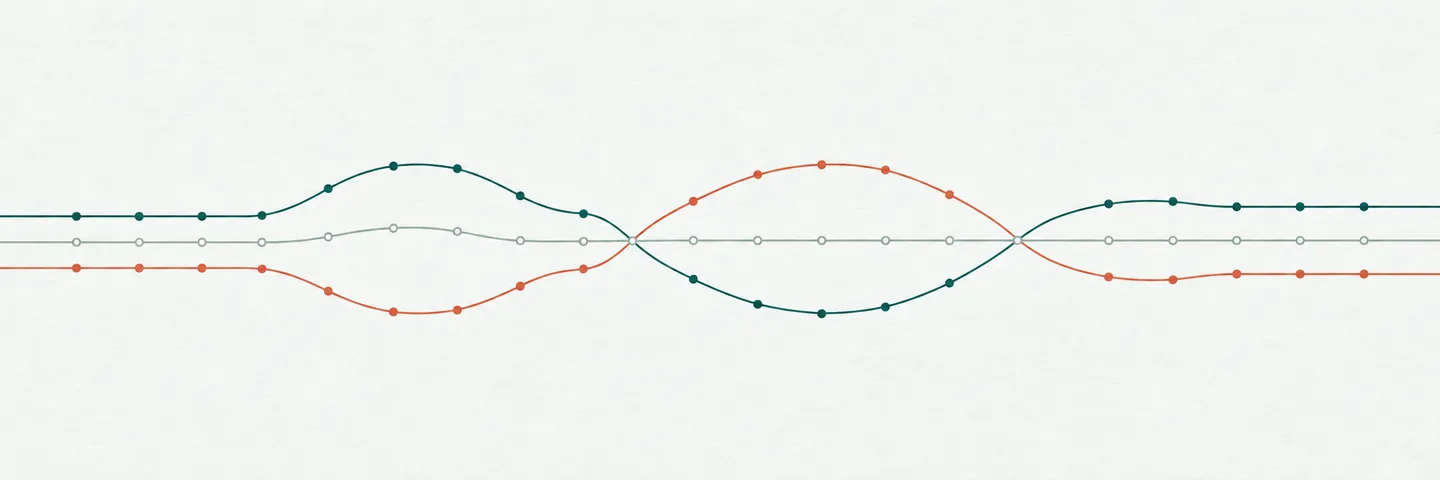
One Chart for the Relationship
A composite chart gives the two people one chart to read together. It uses the Sun, Moon, Mercury, Venus, Mars, Jupiter, Saturn, Uranus, Neptune, Pluto and north node from both birth charts. Each composite point sits halfway between the matching points in those charts. The result is a chart of its own, with positions that belong to neither person's birth chart.
That separate chart gives astrologers a way to talk about the relationship as a shared subject. The composite Sun, for example, is not either person's Sun, and its position does not replace either birth chart. The method turns two sets of placements into one set of midpoints, then reads those points as themes the two people experience together.
Finding the Shorter Midpoint
A midpoint is halfway along the arc between two matching points. There are two possible halfway points because the circle can be travelled in either direction. They sit opposite each other, so the composite method chooses the midpoint on the shorter arc between the two positions. That rule keeps the calculation consistent when the two points sit on opposite sides of the circle.
For example, positions at 350 and 10 degrees have one midpoint at 0 degrees on the shorter arc, and another at 180 degrees on the longer arc. The composite uses 0 degrees. The same choice applies to each pair of matching points, including the planets and the north node.
A Worked Sun Example
The sample couple, two invented people, shows how the calculation works. Person A's Sun is at 5° Libra, with a longitude of 185.78 degrees. Person B's Sun is at 24° Pisces, with a longitude of 354.64 degrees. The shorter arc between them is 168.86 degrees, and its midpoint gives a composite Sun longitude of 270.21 degrees, or 0° Capricorn.
For this same sample couple, the composite Moon is at 5° Aquarius, Venus is at 18° Cancer, and Mars is at 28° Pisces. Each position comes from the midpoint between the matching point in A's and B's birth charts. These examples show the arithmetic and the resulting placements; they do not describe what any other couple's chart contains.
Angles and Equal Houses
The composite Ascendant and Midheaven are included only when both birth times are known. The Ascendant midpoint also has a placement rule: when the nearer midpoint would land on the wrong side of the Midheaven, it is turned to the opposite point. This keeps the composite angles in the intended relationship to one another.
The composite uses Equal houses counted from its Ascendant, with each house 30 degrees wide. This is a method of its own, not either person's house system. The houses therefore describe areas of the composite chart, rather than carrying over the house divisions from A's or B's birth chart.
Composite Chart and Synastry
Synastry places the two birth charts side by side and reads the contacts between their planets. A composite chart creates one new chart from the midpoints, then reads it as the relationship itself. In synastry, the focus stays on how one person's placements meet the other's. In the composite, the focus shifts to themes the two people share.
Each method helps with a different question. Synastry can show how A's placements meet B's, while the composite gives a single picture of the relationship's shared patterns. Using both is common because one method looks at contact between two people and the other looks at the chart formed from their midpoints.
Aspects and Missing Birth Times
The composite points also make aspects to one another, and those contacts are read with the same orbs used elsewhere in chart interpretation. An aspect is the angular relationship between two points. The calculator shows each person's own position beside every midpoint, so a reader can see which two birth chart placements produced a composite point.
Without a birth time, the planets still have positions, but the calculator lists possible signs for a point rather than one settled sign. The Moon can be up to about seven degrees either way, while the Sun can vary by a quarter of a degree. The angles and houses require both birth times, so they are not established from untimed birth details.
A Symbolic Picture, Not a Forecast
A composite chart is a symbolic picture of a relationship, not a verdict on its value or a forecast of what happens next. Its placements can give people language for shared habits and themes, but they do not decide whether two people stay together, change, or separate.
The chart is one way to describe how a relationship feels and what the two people emphasize together. Its meaning depends on interpretation and lived experience. A placement can name a recurring theme without explaining every choice either person makes or reducing the relationship to a single result.
Questions
What is a composite chart in astrology?
It is a chart made from the midpoints between matching points in two birth charts. Astrologers read it as a picture of the relationship the two people form together. It is separate from each person's own birth chart and does not replace either one.
Is a composite chart more important than synastry?
Neither method is more important; they answer different questions. Synastry describes how the two birth charts contact each other, while the composite describes shared themes through one midpoint chart. Looking at both gives two views of the same relationship.
How is a composite chart calculated?
For each point, the calculation finds the midpoint between its position in one birth chart and the matching position in the other. Since two midpoints are possible, it uses the one on the shorter arc. The composite angles and houses also depend on birth times.
Do I need both birth times for a composite chart?
Both birth times are needed to establish the composite Ascendant, Midheaven and houses. Planet positions can still be shown without them, though a point's possible sign may be listed instead of one fixed sign. The Moon's position has greater uncertainty than the Sun's.